Nordic-Baltic Mobility Programme for Public Officials to Develop an Age-Friendly Society
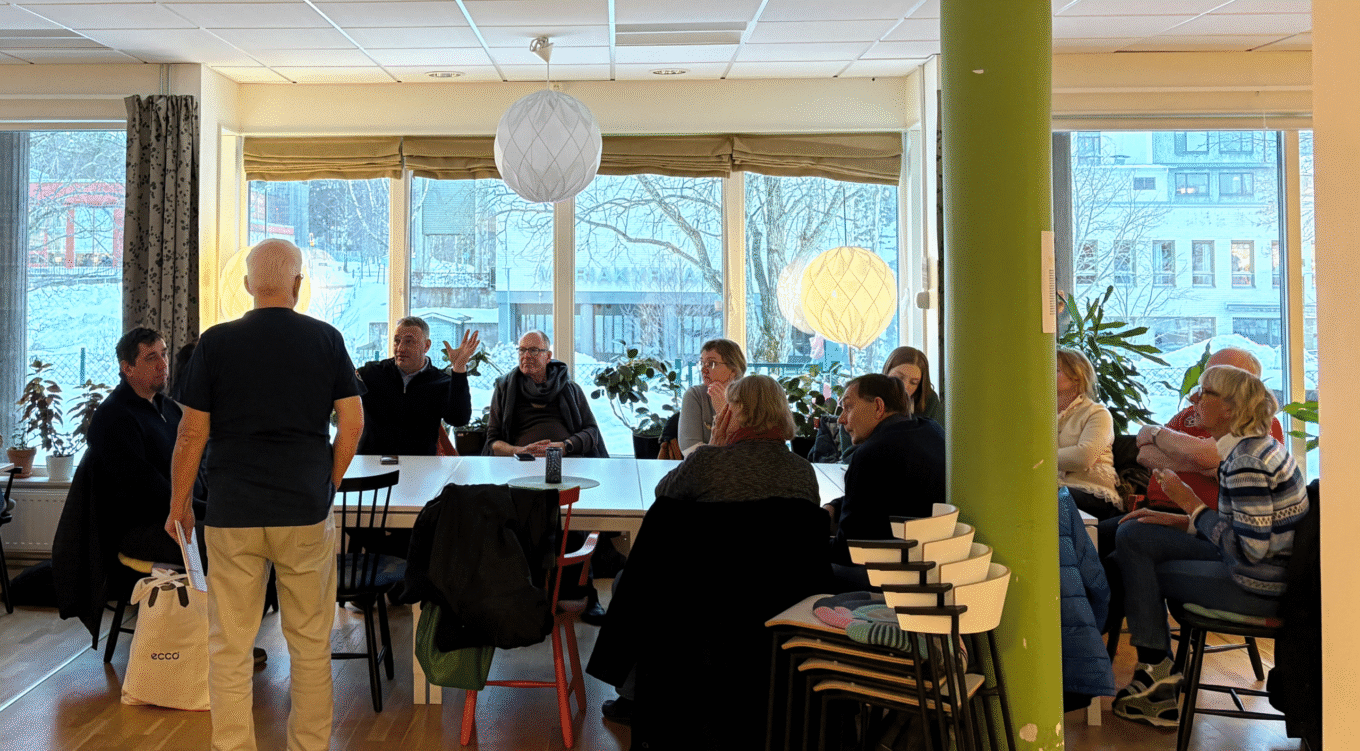
A delegation from Võru Municipality in Estonia visited Gävle Municipality in Sweden in January 2026 as part of a study visit, with the aim of developing a social center for older adults in Võru. The purpose of the visit was to gain experience in creating age-friendly and intergenerational environments. The study trip was supported by the Nordic-Baltic Mobility Programme for Public Administration.
Hemlingborg intergenerational environment
The study visit in Gävle focused on environments where different generations meet in everyday life and where collaboration through various activities is a natural part of working methods. The selection of visited sites was based on Võru Municipality’s interest in solutions that promote social inclusion and strengthen cooperation between different sectors.
Since 2019, Gävle has been a member of the Nordic Network for Age-friendly Cities and Communities, coordinated by the Nordic Welfare Centre. Through this network, the municipality benefits from research, the experiences of other Nordic municipalities, and long-term support. Gävle’s consistent work has led to several concrete initiatives that put the goals of an age-friendly municipality into practice.
One of the main sites visited was Hemlingborg, where a care home, school, kindergarten, and sports hall are located under one roof. According to Gävle’s age-friendly coordinator, Ann-Charlotte Jansson, Hemlingborg demonstrates how a shared location can create natural encounters between different generations. She highlighted that such an environment provides social stimulation and increases the sense of security, especially for older adults and people with dementia. Even simple experiences, such as watching children play, can improve the well-being of older people.
For Võru Municipality, Hemlingborg served as a practical example of how intergenerational solutions can be implemented. Project manager Tiina Hallimäe emphasized the importance of seeing how different functions operate together in daily life and how shared spaces are used flexibly for different target groups. She also highlighted the role of administrative spaces and the importance of staff placement in supporting cooperation – an issue Võru is addressing in the development of its own leisure center.
Karolin Eks, head of the Võru Youth Centre, drew attention to Hemlingborg’s leisure spaces, where different rooms enable creative activities, games, and social interaction after school. For Võru, where the new center is intended to serve multiple age groups, this was a valuable example of how shared spaces can support intergenerational activities.
Tickselbo social community
The visit also included Tickselbo, a sheltered housing-type environment where people over 65 live in independent apartments but have access to shared spaces such as a living room, kitchen, and activity rooms. According to Jansson, such housing models are important for combining independence and social belonging in an age-friendly society. This type of housing is part of the regular housing system and does not require a care decision.
One resident explained that they often gather in the living room to discuss and plan shared activities. The building also has an activity coordinator who helps organize activities and foster a sense of community. Residents collaborate closely with a nearby youth center – they meet, discuss, receive help with technology, and spend time together. They have also baked together in the shared kitchen.
Siiri Toomik, head of the Võru Day Centre for Older Adults, said that the visit to Tickselbo provided ideas for developing activities for older people and improving accessibility in the future Võru leisure center.
Both Toomik and Eks noted that Võru already has intergenerational initiatives, such as handicraft and textile activities and a municipal café where different age groups meet. The study visit provided additional inspiration for strengthening cooperation in the future center.
Study visits as a basis for practical solutions
The visit also offered an opportunity to discuss how to implement age-friendliness in practice and how to establish organization-wide cooperation.
According to Tiina Hallimäe, study visits provide inspiration and new perspectives by allowing participants to see solutions in real-life environments. Võru Deputy Mayor Sixten Sild emphasized that specialists from different fields should participate in such exchanges, as project implementation requires cooperation. When project management, youth work, and services for older adults are all involved, a shared understanding emerges of what intergenerational work means in practice.
For Võru, this was an opportunity to see how age-friendliness can be embedded throughout the entire organization. According to Hallimäe, it is precisely this holistic approach that makes international exchanges valuable.
Age-friendliness is a shared responsibility
Ann-Charlotte Jansson stressed that success depends on cooperation across the entire municipality. The work must be cross-sectoral and not limited only to issues concerning older adults.
Gävle follows the World Health Organization (WHO) model for age-friendly cities, focusing, among other things, on mobility, social inclusion, access to information, and support for relatives. An important part of this work is involving older adults in planning and implementation – this is done through discussions, workshops, and outreach to target groups.
The work is structured within an action plan, where different departments are responsible for implementation in their respective areas. Jansson emphasized that this framework helps to understand that age-friendliness is part of broader development, not a standalone issue.
Mobility programme to support local development
The Nordic-Baltic Mobility Programme for Public Administration is aimed at public sector employees in the Nordic and Baltic countries. The programme supports study visits, internships, and networking activities to strengthen knowledge exchange and cooperation in the region.
Read more about the programme: Nordic-Baltic Mobility Programme for Public Administration
Additional information: Louise Scheel Thomasen, Senior Adviser, Nordic Welfare Centre
Original text: Nordic Welfare Centre