When “Good” Becomes the New Average: Estonia’s Edge in the AI Era May Be Speed

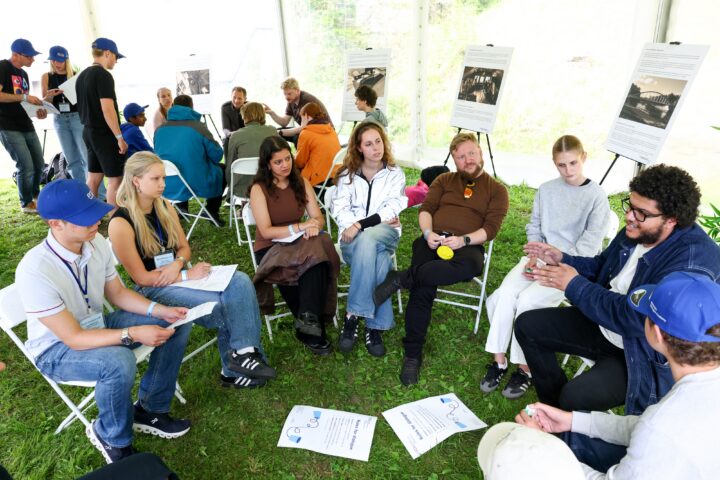
The Nordic Council of Ministers’ Office in Estonia discussion at the Opinion Festival on 7 August 2026: “How Will AI Shape Estonia’s Society in the Next Five Years?” Photo: Kristi Sits
Artificial intelligence may make knowledge and many skills that have traditionally been highly valued accessible to everyone. But that does not mean that people or companies will become equally good at using them.
Experts who took part in discussions at this summer’s Opinion Festival see the key question for Estonia over the next five years differently: how quickly can we learn, adapt and reshape the way we work? Finland has more computing power, Sweden has more capital, but Estonia’s strength could be speed.
If almost every employee can ask AI within seconds to write a decent letter, analyse data, prepare an initial strategy or help with programming, it creates a situation where reaching a level that was considered good just a few years ago is becoming increasingly easy. Yet precisely because of this, a good result is becoming less and less distinctive. This was the starting point for Taavi Tammiste, Head of Software Development and Artificial Intelligence at Reconeyez, who moderated the Nordic Council of Ministers’ discussion “How Will AI Shape Estonia’s Society in the Next Five Years?” at the Opinion Festival on 7 August.
According to Tammiste, the current wave of artificial intelligence differs in some ways from previous technological leaps because AI is rapidly changing people’s capabilities on a very broad scale. “The new average is what used to be considered good. It has never been easier to be good, and ironically, it has never been less valuable,” he said, capturing the dilemma.
So the question is no longer simply who knows how to use AI. The question is where an individual, company or entire country can find the ability to be above average when the average itself has become cheap and readily accessible.
The discussion brought together Toomas Polli, Deputy CEO of Elisa Estonia and CTO of Elisa Finland; Reet Kaurit, co-founder and recruitment partner at TalentHub Recruitment; Kirke Maar, Head of the Estonian Government Office’s Eesti.ai team; and Priit Salumaa, founder and CEO of Better Medicine.
AI may not take away jobs, but it will change what they involve
The panelists first challenged one of the most common fears: that artificial intelligence will push large numbers of people out of their jobs in the coming years. In Reet Kaurit’s view, it is more likely that AI will not eliminate jobs as such, but rather some of the tasks within them. “People are afraid that AI will replace them. I would say instead that jobs will not disappear, but the parts of the work that we enjoy the least will be replaced,” she said.
Toomas Polli agreed. In software development, he said, there have been predictions for years that AI will make a large proportion of developers unnecessary. He looks at the technology from the opposite perspective: “If AI can take on some of the work people currently do, we should give people more complex problems to solve, rather than simply reducing their numbers.”
Kirke Maar also described the rapid and widespread disappearance of jobs as a myth. In her view, the opposite could even happen in the coming years. “Initially, adopting AI requires more people, because companies and public institutions have to redesign processes, learn new ways of working and build new systems. Only later may it become possible to do the same work with less time,” she said.
The transformation is even slower in healthcare. Priit Salumaa referred to the claim that AI is already making a large proportion of diagnoses. In his view, this does not reflect reality. AI solutions are certainly being used — for example in radiology, image processing, stroke detection and digital pathology — but in healthcare they are currently mostly narrow tools designed to perform specific tasks.
“AI has not yet permeated medicine to such an extent that it is everywhere,” Salumaa said.
AI skills will become as commonplace as knowing how to use Word
According to Kirke Maar, it is difficult to measure how widely artificial intelligence is actually used in Estonia, partly because statistics in this field become outdated very quickly. Statistics Estonia data show that in 2025, 22% of Estonian companies used at least one AI technology. Maar also referred to studies suggesting that around half of the population already uses AI tools, with the share potentially much higher among young people.
The problem, she said, is no longer so much whether people have tried ChatGPT or another tool. The much greater challenge is actually integrating AI into a company’s work processes.
“This is not a software issue. It is an issue of processes and habits,” Maar stressed.
Companies need to be prepared to change how work is organised and decisions are made, while employees need the courage to experiment with new solutions — as well as an understanding of what AI should not be used for.
Some of these changes have already taken place at Elisa. According to Polli, around half of the company’s software code is currently produced with the help of AI, while in customer service, artificial intelligence can handle some conversations from beginning to end without human intervention.
In recruitment, Kaurit said, AI use among candidates in the technology sector is becoming so commonplace that listing it separately on a CV is starting to resemble highlighting one’s ability to use Word. “It is simply becoming part of every job and every profession,” she said.
This, in turn, changes the question for employers. If almost every candidate can use AI to produce a good CV, polish a cover letter, prepare an analysis and gather information, a merely polished result can no longer be a competitive advantage.
A good intern does not make a good CEO
So what will set people apart? According to Kaurit, qualities that are much harder for artificial intelligence to replace will become increasingly important.
“The ability to lead people, make sense of knowledge, work in a team, make decisions and take responsibility for them. AI is a very good intern — it conducts research and analysis quickly — but a very bad CEO,” Kaurit said by way of comparison.
AI can offer options and analyse situations, she said, but setting priorities that matter to a company, choosing the right people and taking responsibility in situations of uncertainty will remain the responsibility of humans.
Polli also believes that a 21-year-old today should not focus so much on what exactly to study, but rather on whether they are ready to work in an environment that is constantly changing. The era when a person learned one profession and then essentially performed it in the same way for the next twenty years is increasingly becoming a thing of the past, he said. “The valuable employee of the future is a lifelong learner.”
Kaurit expressed the same idea more simply: “Education may get you your first job, but the ability to learn and adapt will take you through all the next steps of your career.”
In her view, even hobbies can tell an employer a great deal about a person. Someone who has spent years learning an instrument or reaching a high level in sport has had to practise, fail, try again and continually develop themselves. “That ability to learn may become more valuable than ever in the labour market of the future.”
Schools cannot simply allow students to use ChatGPT
If the ability to learn becomes increasingly important, the inevitable question is whether Estonia’s education system is ready for this change.
“No, we are not ready,” Maar answered directly.
According to her, students are already actively using artificial intelligence, but teachers, rules and existing teaching models are struggling to keep up. “The change cannot be limited to whether ChatGPT is allowed or prohibited in the classroom. We need to rethink what and how we teach,” she said.
Maar stressed that academic education will remain essential in fields where deep specialist knowledge cannot be replaced — for example medicine, engineering and mathematics. At the same time, she believes the number of professions in which a traditional degree alone provides a strong advantage in the labour market is changing rapidly.
This is particularly relevant to young people looking for their first job. “It is difficult for young people to find junior positions because of AI,” Maar said. In her view, this means that universities and vocational schools need to provide graduates with more experience in project-based work, problem-solving and collaboration across different fields.
Salumaa added another skill whose importance he believes will increase sharply in the AI era: critical thinking. An AI-generated answer can be highly convincing even when it is wrong. “AI can hallucinate incredibly convincingly or, to put it bluntly, lie,” he noted.
Blind trust can pose a real danger to patients in healthcare, but the same principle applies beyond medicine, he said. People need to be able to ask whether an answer makes sense, what assumptions it is based on and whether it can be trusted.
Finland has computing power, Sweden has capital and Estonia has speed
One of the central questions of the discussion was how Estonia positions itself in the AI race compared with its Nordic neighbours.
Toomas Polli, who works across both the Estonian and Finnish markets, highlighted computing power as a major difference. Finland, he said, has made strategic investments in data centres and AI infrastructure, with further major investments planned.
Estonia’s strength lies elsewhere, in his view. “We have less bureaucracy, strong digital-state infrastructure, active start-up entrepreneurship and a habit of doing things quickly with fewer resources.”
Maar, in turn, pointed out that Sweden and Finland have more capital than Estonia, while Finland has very strong cooperation between science, investors and deep technology. “We cannot compete with the amount of capital they have,” she said.
However, Estonia can compete on speed. “Estonia is very flexible. We are used to doing things faster and with less funding,” Maar added.
Polli also sees a difference between Estonia and Finland in their attitudes towards risk. In his view, Estonia tends to start more quickly, take more risks when making decisions and adjust course later if necessary. “I believe that in this sense, we move faster,” he said.
According to Kaurit, the same flexibility is important when competing for talent. Estonia’s labour market is very small and, following the rapid expansion of remote work, Estonian companies are no longer competing for talent only with Sweden or Finland, but essentially with the entire world. Therefore, the ability of a small country to make decisions quickly should not be taken for granted as an advantage.
In healthcare, a “good average” would already be a huge achievement
While AI-driven standardisation may make it harder to stand out in business, the situation is different in healthcare. A situation in which all patients receive care that is consistently of a good standard would already be a significant achievement.
At the same time, there are good reasons why AI adoption is moving more slowly in medicine. Salumaa gave the example of Better Medicine’s AI solution for detecting kidney cancer. In order to be used as a medical device, software must undergo extensive certification and comply with European requirements. According to him, the certification process alone can take 18–24 months and cost hundreds of thousands of euros or more for a software solution.
“Doctors only want to use solutions that have been thoroughly tested and whose safety for patients has been demonstrated,” Salumaa said. In his view, such caution is necessary.
However, a major untapped opportunity for Estonia lies in data. Estonia has decades of experience as a digital state and a great deal of health data, but according to Maar, this data is not yet being used sufficiently for research and the development of new technologies.
In her view, it should be possible to create technical solutions where the data remains securely within state registers, while researchers and companies can access it in a controlled way for testing purposes.
The potential benefits of AI are not limited to diagnosis. Maar pointed to doctors’ documentation burden, which can account for 20–30% of their working time. “If artificial intelligence took over part of this work, doctors could spend more time with patients.”
The panellists saw an even greater opportunity in disease prevention. According to Statistics Estonia, life expectancy in Estonia in 2025 was 79.8 years, while healthy life expectancy was only 57.3 years. With an ageing population, Salumaa believes the question of how to help people remain healthy for longer will become unavoidable.
In his vision, within five years a person could have a personal AI-based health agent that monitors their health risks, reminds them about necessary check-ups, finds a suitable appointment with a doctor and makes sure that the patient does not get lost between different parts of the healthcare system.
This would not eliminate the doctor, however. When the audience was asked whether people would be willing to receive a diagnosis solely from AI and without a doctor’s involvement, the reaction was telling.
“You might get a diagnosis, but would you ask a real doctor for a second opinion? I would,” Salumaa said.
The state of the future could know what a person needs before they do
Artificial intelligence could bring a similar transformation to the public sector.
The national Eesti.ai initiative has a goal of increasing the size of Estonia’s economy by 25% over five years and, in the longer term, increasing the value of people’s work. According to Maar, this change will not come from one major AI project, but from many concrete solutions in business, healthcare and the public sector.
“One of the goals of Eesti.ai is to bring AI skills to a large number of people, so that people know how to use the technology to do their work, but also understand its limitations,” Maar said. Looking five years ahead, she sees an opportunity for Estonia to move from being a digital state towards an “agentic state”.
Instead of people having to know for themselves which benefit, allowance, health check or public service they are entitled to, the state could proactively provide the relevant information.
“My dream is that the state would have proactive and predictive notifications for citizens for its core services,” Maar said.
This would also change the current understanding of the digital state. Today, the success of e-government is often measured by how quickly a person can find the service they need online and complete the necessary transaction themselves. The next step could be a situation in which they do not need to search for that service at all.
However, artificial intelligence should not take over responsibility. At the end of the discussion, the panellists were asked how much decision-making people should delegate to AI.
Maar’s answer was clear: “Responsibility must remain with the human. A doctor, manager, official or prime minister can use AI for analysis, to play through different options and prepare a decision, but the mandate and responsibility cannot be handed over to technology.”
Polli described AI in a similar way, more as a sparring partner. One can approach AI with an initial position, have it test different arguments and then change one’s mind if necessary, but the final decision remains with the person.
The biggest change in five years may not be technological at all
By the end of the panel, the message was not a prediction that machines would do people’s jobs by 2031. Rather, a picture emerged of a world in which AI has become so commonplace that simply knowing how to use it will no longer distinguish anyone.
A teacher may regain time currently spent preparing and marking assignments. A doctor may be freed from some of their documentation work. A recruiter may no longer need to take notes during an interview. A software developer may be able to create code faster. The state may be able to identify a person’s needs before that person even knows which service to look for.
But precisely then, the skills that are harder to automate become more valuable: decision-making, taking responsibility, curiosity, critical thinking, communication, creativity and the willingness to keep learning.
The same logic applies to Estonia. We do not have the most capital or the greatest computing power, and the number of talented people available to us is inevitably limited by our size. Our advantage can be our ability to try faster, fail faster, learn faster and change direction faster.
Maar summed up this idea as advice to young people: “Do what you love and find a way to use AI so that it does the things you don’t love doing.”
Perhaps this is at the heart of Estonia’s AI challenge for the next five years. Not to use artificial intelligence to make people as uniformly efficient as possible, but to use technology to give people more time to do what humans are still best at.
Watch the discussion here: https://youtu.be/ZLSZaXZNei0?si=W8Ui0NMnnydr8V3a
The article was written in cooperation with Delfi Geenius Media, by Hetlin Villak-Niinepuu.